Business Support Development PowerPoint
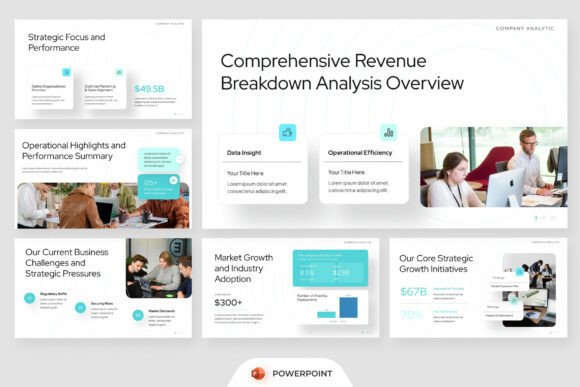
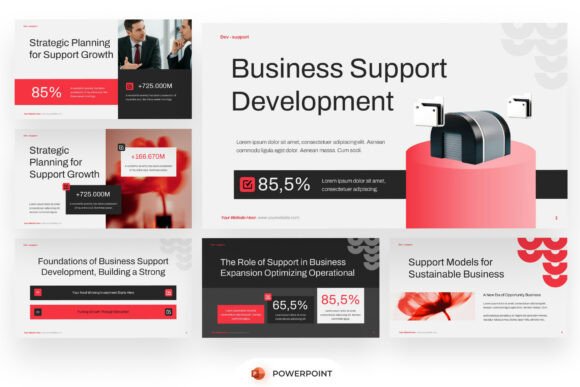
If you've ever spent hours formatting slides—adjusting fonts, realigning charts, or struggling to make complex operational strategies look clear and confident—you’ll appreciate what the Business Support Development PowerPoint template offers. It’s not just another slide deck—it’s a purpose-built, corporate-grade presentation framework designed for teams that need to communicate business operations, strategic planning, support systems, and growth pathways with clarity and authority.
This template stands out because it balances visual impact with practical utility. Its bold, modern layouts include dedicated sections for performance highlights, infographic-driven data storytelling, business growth timelines, and structured service overviews—all built around a 16:9 widescreen ratio. Whether you're a startup founder pitching to investors, a consultant aligning stakeholders on process improvements, or an operations manager reporting quarterly KPIs, the structure helps you focus on *what* you say—not *how* to make it fit.
Common Missteps—and Why They Slow You Down
Many users rush into downloading or customizing the Business Support Development PowerPoint without first checking whether it fits their actual workflow. One frequent oversight is assuming “editable” means “plug-and-play.” While every slide is fully customizable in PowerPoint, that doesn’t mean all elements behave intuitively. For example, some users try to replace placeholder icons with custom SVGs only to find alignment shifts or layer conflicts—especially if they skip reviewing the included Help Guide files. That small detour can cost 20–30 minutes of troubleshooting per slide.
Another overlooked detail is font handling. The package includes a free font—but only the .ttf file. If you’re working across devices (say, editing on a Mac and presenting from a Windows laptop), and you haven’t installed that font system-wide, PowerPoint may auto-substitute it with something generic like Calibri. Suddenly, your clean, bold headline looks soft and unpolished. That subtle mismatch undermines the professional tone the template was designed to deliver.
Some professionals also mistake the template’s scope. Because it includes layouts for investment planning and organizational development, they assume it covers financial modeling or HR policy documentation. It doesn’t. It provides *presentation-ready visuals* for those topics—not spreadsheets, legal disclaimers, or editable policy text. Using it as a substitute for domain-specific content creation leads to vague messaging and weak audience trust.
What Happens When These Gaps Go Unchecked?
When font substitution occurs mid-presentation, readability drops—especially on large venue screens. A title that looked sharp in your office may blur or compress during a client meeting, making your strategy seem less deliberate than it is.
Skipping the Help Guide often results in inefficient customization. Users sometimes rebuild entire slides from scratch instead of using the built-in master layouts and grouped objects—doubling their workload and losing consistent spacing, color logic, and animation triggers baked into the original design.
Worse, misreading the template’s intent can dilute your message. Imagine using a “Business Growth Layout” to present a six-month marketing campaign—but filling it with bullet points instead of milestone-based visuals. You’ve missed the opportunity to show momentum, sequencing, and measurable outcomes—the very strengths this template was engineered to highlight.
How to Use It Well—Without Overcomplicating Things
Start by opening the Help Guide *before* you open the .pptx file. It walks you through layer naming conventions, how to safely swap images (hint: use the “Selection Pane” to avoid accidental deletions), and which shapes are grouped versus locked. Ten minutes here saves an hour later.
Install the included font on every device you’ll use—even your presentation laptop. On Windows, right-click the .ttf file and select “Install for all users.” On macOS, double-click and click “Install Font” in Font Book. Then re-open the presentation and run “Replace Fonts” under Home > Replace > Replace Fonts to confirm consistency.
Respect the template’s architecture. Each section has a role: the “Performance Highlights” slide isn’t for raw data dumps—it’s for distilling 3–5 key metrics into visual anchors (think bar comparisons, trend arrows, or progress rings). If your team tracks customer retention, NPS, and cycle time, use those three—not eight. Clarity beats completeness every time.
And remember: stock images aren’t included. That’s intentional. It pushes you to use your own branded assets, real team photos, or licensed visuals that reflect your company’s voice—not generic clip art. If you’re short on time, use tools like Unsplash or Pexels with filters for “corporate,” “team collaboration,” or “data dashboard”—and always resize before inserting to preserve sharpness.
Before You Download or Present—A Quick Checklist
- Verify your PowerPoint version: This template uses standard PowerPoint features—but older versions (pre-2016) may not render transitions or gradient fills correctly. Test one slide first.
- Check image resolution needs: If you plan to print handouts or export to PDF, ensure any custom charts or screenshots are at least 150 DPI at full size.
- Review licensing scope: You’re free to edit, share internally, and present publicly—but reselling the template or offering it as part of a client deliverable requires separate permission.
- Test accessibility: Run PowerPoint’s built-in Accessibility Checker (under Review > Check Accessibility). It flags low-contrast text or missing alt text—small fixes that make your message inclusive and more credible.
Finally, don’t treat the Business Support Development PowerPoint as a replacement for preparation. A powerful template amplifies strong content—it doesn’t generate it. Spend time refining your narrative flow *before* you drop it into slides. Map your core message to the template’s natural sections: start with context (Operations Overview), move to evidence (Performance Highlights), then outline next steps (Growth Roadmap). Let the design support your logic—not distract from it.
Used thoughtfully, this template helps you speak with confidence, organize complexity without oversimplifying, and keep your audience focused on what matters most: your strategy, your team, and your progress. It won’t write your script—but it will help you deliver it, clearly and professionally.