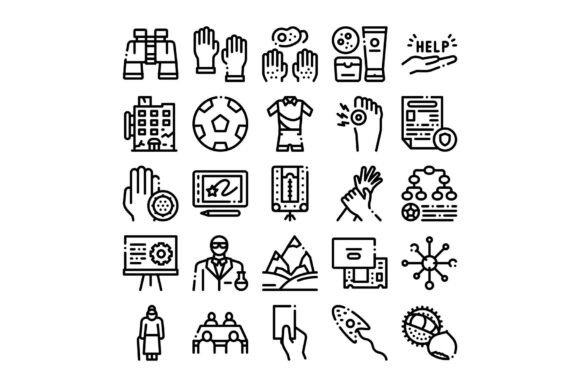
Outline Icons Set Illustrating Various C
Real-World Applications Across Creative Disciplines
• Branding & logo design: Use individual icons as supporting visual motifs in sub-brands, service badges, or modular logo extensions—especially effective for healthcare startups or academic institutions emphasizing transparency and approachability.
• Digital marketing & social media graphics: Streamline content creation by pairing icons with concise copy—think Instagram carousels explaining medical conditions or LinkedIn posts highlighting research milestones.
• Web & app interfaces: Integrate into navigation menus, feature cards, or progress indicators. Their consistent stroke weight and negative space handling ensure accessibility and responsiveness across devices.
• Editorial & infographic design: Elevate data storytelling—pair nature icons with environmental statistics or social interaction symbols with behavioral insights—to reinforce meaning without clutter.
• Packaging & print design: Scale confidently for product labels (e.g., sports nutrition supplements) or educational brochures (e.g., public health campaigns), maintaining crispness in both digital proofs and CMYK output.
Selecting & Integrating With Intention
- Consistency first: Verify uniform stroke width, corner radius, and optical alignment across categories—subtle variations can undermine professionalism in branding or UI design.
- Audience alignment: Icons representing medical conditions should prioritize clinical accuracy over stylization; those for social interactions benefit from inclusive, culturally neutral gestures.
- Typography harmony: Pair with sans-serif typefaces that share similar x-heights and geometric sensibilities—avoid clashing weights or overly decorative fonts that distract from icon clarity.
- Workflow compatibility: Ensure SVG files are cleanly layered and named logically (e.g., “health-heart-rate.svg”) to simplify handoff between designers, developers, and marketers.